

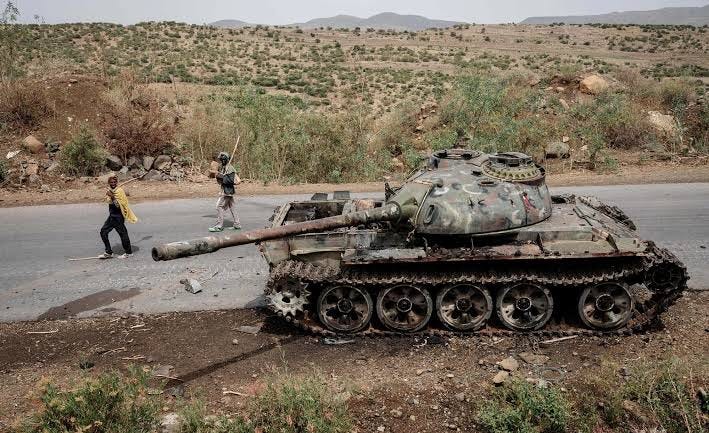
Mekelle, Tigray (Wegahta) - Fighting broke out at around 6:00 a.m. around the town of Shererina in Western Tigray, according to sources close to the situation, raising fears that months of worsening political tensions between Tigray’s ruling party and the federal government could spill back into open conflict.
The clashes, which multiple sources said began earlier this morning, reportedly involved TDF unit known as “Army 70” fighters, based across the border in Sudan and the Ethiopian National Defense Force. Several reports alleged that the fighting involved heavy artillery, mechanized units and use of drones, however Wegahta could not independently verify the claima.
In a statement issued on Saturday, Tigrayan authorities accused the federal government of initiating an attack against Tigrayan forces in Western Tigray. The allegations could not be independently verified, and the federal government had not commented on the claims at the time of publication.
The reported fighting comes amid steadily deteriorating relations and confrontational rhetoric between the federal government in Addis Ababa and the TPLF, with both sides accusing each other of undermining the November 2022 Pretoria peace agreement that ended the two-year war in Tigray heightening concerns among residents, diplomats, analysts and humanitarian organizations that the fragile peace could unravel.
The latest political crisis began after the TPLF rejected the federal government’s decision to extend the mandate of the Interim Regional Administration led by Lieutenant General Tadesse Werede. The party argued that Addis Ababa had acted unilaterally, without consultation with Tigrayan stakeholders, and said the extension violated the Pretoria Agreement, which it says envisioned a transitional administration that would be established based on consultation between the TPLF and the Federal government.
In response, the TPLF dissolved the federally recognized interim administration and reinstated Tigray’s pre-war regional institutions, describing the move as necessary because the federal government had failed to implement key provisions of the Pretoria Agreement. TPLF leaders have repeatedly argued that core commitments including the withdrawal of non-federal forces from Western Tigray, the return of displaced residents, restoration of constitutional governance and the full implementation of the agreement remain unfulfilled nearly four years after the agreement was signed.
Federal authorities and the Federal appointed interim administration rejected the move, saying the reinstatement of the pre-war governing structure effectively nullified the Pretoria Agreement and challenged the framework established after the war.
The political dispute has since evolved into an increasingly volatile security confrontation. Both sides have traded accusations of ceasefire violations, while reports of military mobilizations, clashes and drone strikes have heightened fears that the fragile peace is deteriorating.
TPLF officials have accused the federal military of carrying out drone attacks inside Tigray and preparing for a renewed military operation, allegations the federal government has not publicly acknowledged, while Prime Minister Abiy Ahmed has accused Tigrayan forces of repeated provocations and warned against actions that could trigger another war.
Analysts say the dispute reflects competing interpretations of the Pretoria Agreement itself. While Addis Ababa maintains that the interim administration remains the legitimate transitional authority until constitutional processes are completed, the TPLF argues that the federal government’s unilateral decisions and delays in implementing the accord have fundamentally undermined the agreement.
The unresolved status of Western Tigray, incomplete security arrangements, and the continued presence of armed actors in and around the region have become central points of contention, leaving the peace process increasingly vulnerable to renewed military confrontation.
The Regional Stakes of the Escalation
That the reported fighting erupted in Western Tigray is significant not only because it threatens Ethiopia’s fragile peace process, but because it occurred at the intersection of several of the Horn of Africa’s most volatile geopolitical fault lines.
The clashes were reported in Shererina, Western Tigray, close to Ethiopia’s border with Sudan, where more than three years of civil war between the Sudanese Armed Forces and the Rapid Support Forces have transformed the frontier into one of the Horn of Africa’s most militarized and politically complex regions.
Since the war began in April 2023, Sudan has become one of the world’s largest humanitarian crises, with millions displaced and allegations of foreign involvement intensifying the conflict. Both sides have accused regional powers of supporting their opponents, while neighbouring countries and regional powers have been drawn into competing diplomatic & security calculations.
Ethiopia has repeatedly denied taking sides in Sudan’s war, but it has faced accusations from Sudanese actors and regional observers over alleged involvement. Sudanese authorities have accused Addis Ababa of supporting the RSF, claims Ethiopia rejects. At the same time, Ethiopia has accused the SAF of allowing hostile groups to operate inside its territory and providing support.
Amid this accusations and disputes the proximity of Western Tigray to Sudan has increased the strategic importance of the area with analysts warning that renewed fighting in Western Tigray could have consequences beyond Ethiopia’s borders.
For Tigrayan residents, fears of another war return
For many Tigrayan residents, reports of new fighting have revived painful memories of a conflict that killed hundreds of thousands of people, displaced millions and left much of the region’s infrastructure destroyed.
Residents across Tigray expressed concern that renewed hostilities could deepen an already severe humanitarian crisis and further delay efforts to rebuild communities after years of war.
“We have not yet recovered from the last war,” one Tigrayan resident of Shire told Wegahta Facts, asking not to be identified due to security concerns. “People are still trying to rebuild their lives and return to normal. Another conflict would bring more suffering.” Many communities in Tigray are still dealing with the consequences of the previous conflict, including displacement, damaged livelihoods and delayed recovery and reconstruction efforts.
The reported clashes in Western Tigray come at a critical moment for Tigray’s fragile peace process, with residents watching closely to see whether the latest tensions can be minor escalation or whether the region risks sliding back into another devastating conflict.